
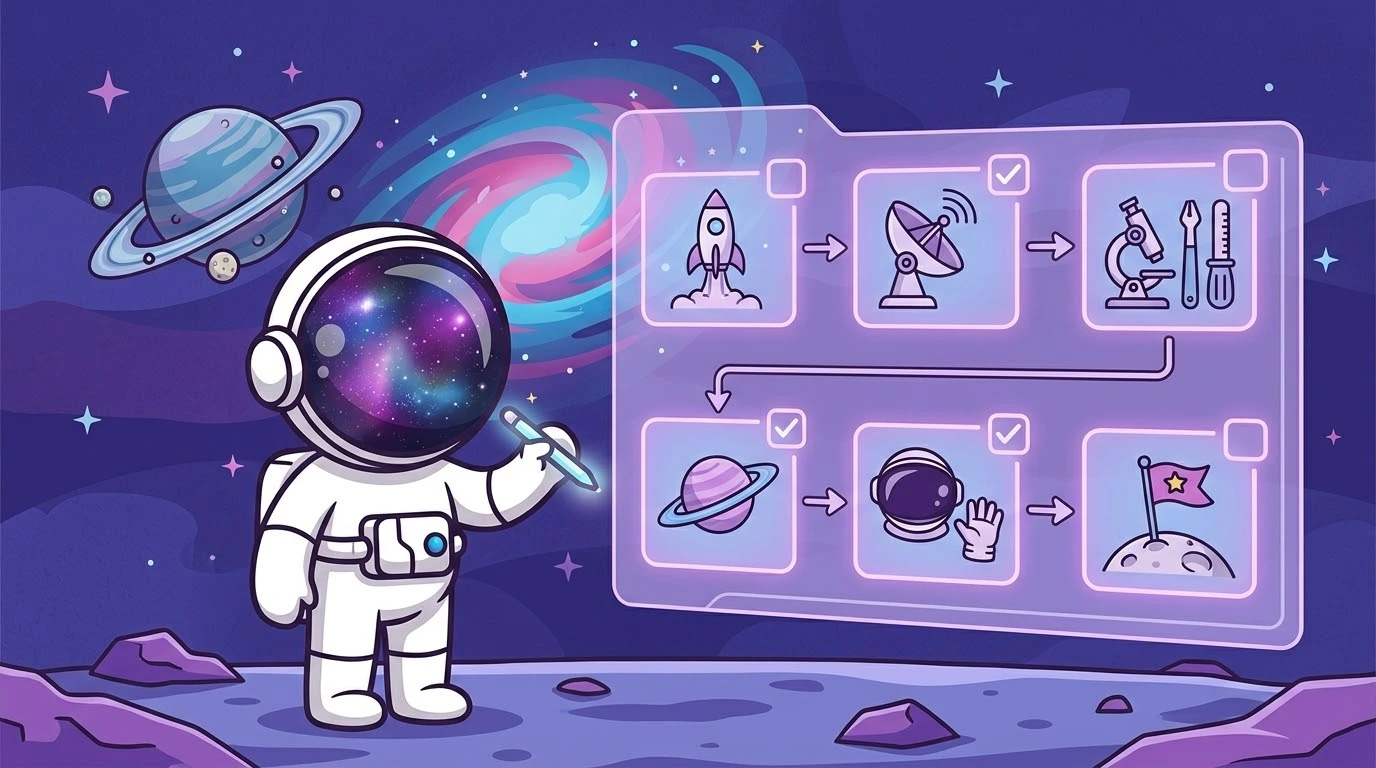
Project management is the process by which a team plans, organizes, and carries out a specific, time bound goal. It isn’t a single tool or method — it’s a way of thinking that organizes tasks, deadlines, and people around a shared outcome.
How is project management different from everyday task management
Task management is about getting a given item done: someone owns it, it has a deadline, and it has a status. Project management sits one level above that. It doesn’t look at a single task — it looks at how tasks relate to each other: what depends on what, in which order things need to happen, and how it all adds up to a shared result.
A team can work with the same tasks without any project management at all, as long as the work is repetitive and there’s no hard deadline. But once several tasks build on each other and there’s a specific finish line, a plain task list stops being enough. You need to see the whole, not just the pieces.
When does a piece of work count as a project
Not all work is a project. Ongoing, repeating work — weekly customer support tickets or routine bookkeeping tasks, for example — isn’t a project but operational work: it has no start or end date, and the tasks repeat in a similar pattern.
A piece of work becomes a project when:
- it has a clear, specific outcome (launching a product, rolling out a system, wrapping up a campaign),
- it has a start date and an end date,
- most of its tasks build on one another rather than running independently,
- it requires coordinating the work of several people or teams.
If several of these are true, it’s worth treating the work as a project, with its own plan and tracking, rather than folding it into the daily task list.
What makes up a project
A well structured project breaks down into a few core elements:
Goal. What needs to be achieved, and how you’ll know it’s done. A vague goal (“improve the process”) gives planning nothing to hold onto, so it’s worth stating it in a measurable form.
Tasks. The concrete steps toward the goal, each with an owner and a deadline. In a larger project these often break down further into subtasks.
Sequence and dependencies. Which task has to come before another, and which ones can run in parallel. This is what shapes the project’s schedule.
Milestones. The project’s checkpoints, where it’s worth pausing to confirm the work is heading in the right direction.
Ownership. Who’s responsible for the project as a whole, and who’s responsible for each task. These are often not the same person.
What project planning actually does
Project planning is the step where the elements above turn into a workable plan: what gets built, in what order, under whose responsibility, and by when. A good plan doesn’t matter because it predicts everything correctly — reality will override parts of it regardless — but because it sets the reference point that progress can be measured against.
Without it, individual tasks might get finished, but the team won’t be able to say whether things are actually on pace for the final deadline.
The practical payoff of project management
Project management isn’t paperwork or unnecessary admin — it earns its keep when the team runs into fewer surprises along the way. A single task slipping is rarely the real problem; the real problem is when that slip ripples unnoticed into the tasks that depend on it, and only surfaces once the deadline is close.
When planning a project, it’s worth clarifying dependencies and ownership early on — we cover this in more detail in our article on task dependencies.