
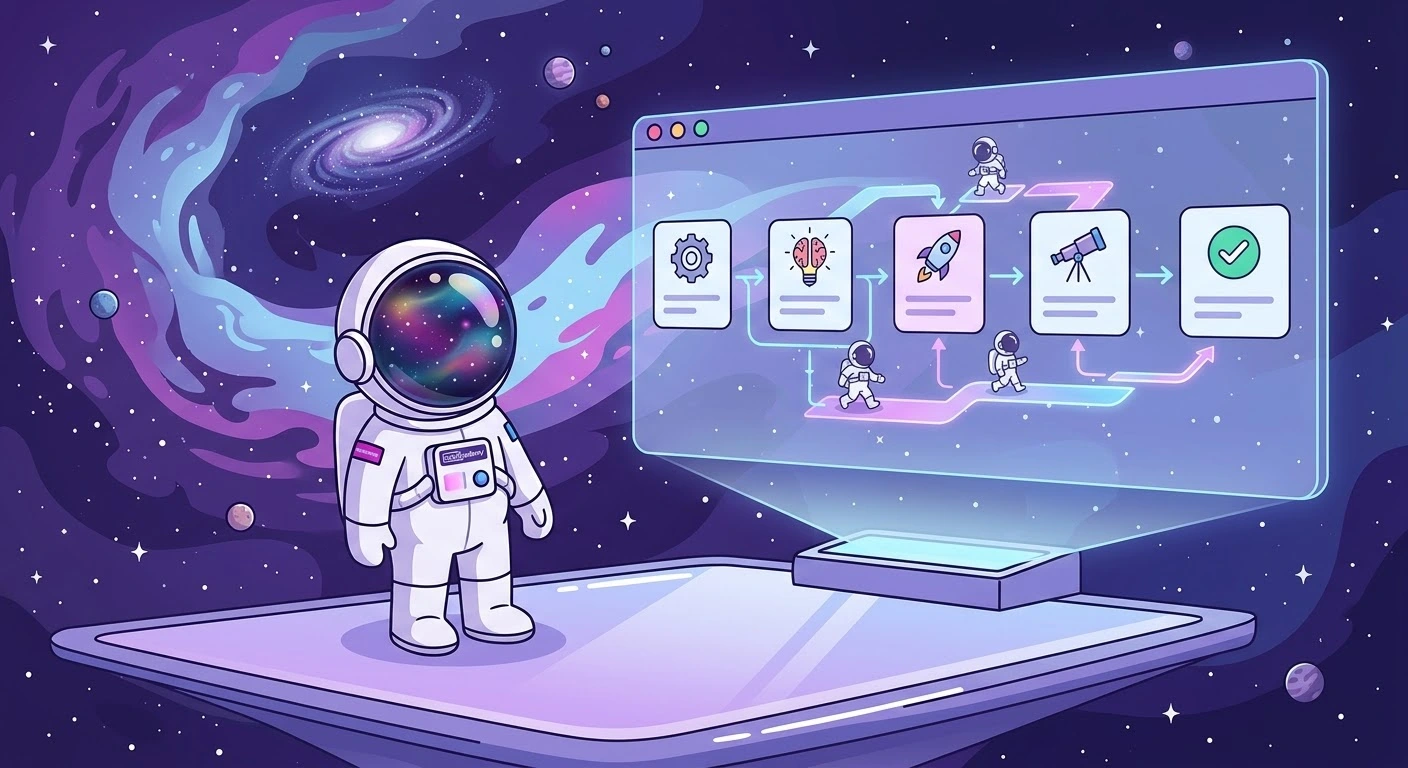
Task management organizes the day-to-day work: who’s doing what, what’s next, what’s the status. Project management sits one level above that — it determines how a team gets from a specific, time-bound starting point to a defined outcome. The two aren’t mutually exclusive: a project is made up of tasks, and task management is the tool you use to execute it.
What task management actually is
Task management deals with the smallest, independently completable units of work. A task has an owner, a status, maybe a deadline — but on its own, it doesn’t tell you where it fits into the bigger picture.
This level is enough when a team’s work is continuous and repetitive: handling client requests, routine maintenance work, support tickets. There’s no start or end date, no one-time goal — just a steady stream of tasks arriving and closing.
What project management actually is
Project management comes into play when work has a beginning, an end, and a specific, defined outcome. Building a website, moving offices, launching a product — these are all projects: the tasks here don’t exist in isolation, they’re arranged around a shared goal, often building on one another.
Compared to task management, project management adds a layer on top:
- Scheduling — when each step needs to start and finish for the project as a whole to land on time.
- Sequencing — which tasks depend on others, and which can run in parallel.
- Milestones — checkpoints along the way that signal whether the project is on pace.
- A shared endpoint — the project ends when the goal is reached, not when a list of tasks runs out.
Why the line rarely stays clean
In practice, most teams do both at once — they just don’t name them separately. A project breaks down into tasks, and those tasks still need owners, statuses, and deadlines just like any standalone to-do. The real difference isn’t at the task level — it’s whether a team or project needs a custom workflow of its own, and whether tasks depend on each other in a way that makes order matter.
That’s why it helps to think of the two as different zoom levels on the same work, not two separate systems:
- Task view: what do I need to do today, what’s waiting, what’s its status.
- Project view: where do we stand against the goal, what’s late, what’s blocking something else.
When task management is enough, and when you need a project mindset
If a team’s work is mostly made up of unique, recurring to-dos with no shared deadline or endpoint, task management on its own works fine. But when several tasks depend on a common goal and a common deadline, and a delay in one ripples into the others, that’s a project — whether anyone calls it one or not.
This is the most common practical mistake: a team is running a project but managing it like a task list. Individual tasks move along fine, yet the end result still slips, because no one is looking at the whole — only its pieces.
How to recognize this in your own team
A simple test: if you can point to exactly which other task or deadline is affected when a given task slips, you’re thinking at the project level. If a task’s delay stands on its own with no downstream effect, the work is probably still at the task-management level.
The practical takeaway isn’t that every piece of work needs to be treated as a project — it’s deciding, deliberately, which level you actually need before your team tries to track something in a list or spreadsheet that really calls for scheduling and sequencing instead.